



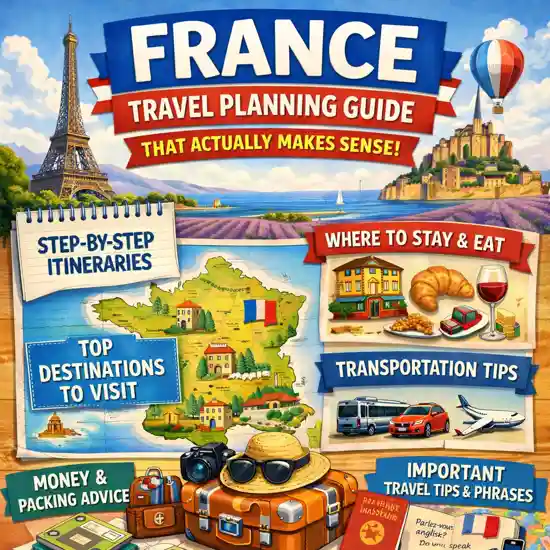
Planning a trip to France sounds easy when it is still just an idea. You open a few tabs. Save some pretty photos. Tell yourself this one will be simple. Paris for a few days maybe. Then the south. Maybe a train ride somewhere in between. It all feels very neat in your head.
Then real planning starts.
Hotel prices jump around. Train times look fine until you realise the station is not close to your hotel at all. One place you wanted to visit is suddenly three hours away from the next one. Now you are comparing neighborhoods, checking luggage rules, looking at airport transfers, wondering how many cities are too many, and somehow the trip that felt exciting starts feeling like homework.
That is usually the point where people mess it up a little.
They try to make the perfect France itinerary. France does not really need a perfect itinerary. It needs a sensible one. That is the whole difference.
If you are looking for a France travel planning guide that feels practical and not weirdly polished, this is the one I would give a friend before their first trip.
You may also Like:
Start with the kind of trip you actually want
This sounds obvious but most people skip it.
They start with famous places instead. Paris, Nice, Lyon, Bordeaux, Strasbourg, maybe Annecy too because it looks beautiful in photos. The list gets longer and longer and for a minute it feels exciting. Then you look at the map properly and realise you are building a trip where half your memories will come from stations, taxis, hotel lobbies and dragging a suitcase over stone streets.
France is not one thing. That is the first thing worth understanding.
Some people want the classic version of France. Big landmarks, old streets, museums, café tables, river views, maybe a few famous photos. That is usually Paris and one more place.
Some people want a slower trip. Morning bakery runs. Local markets. Smaller towns. Long lunches. A few lazy walks without checking the time every ten minutes. That kind of trip works better in smaller regions and not in a five-city plan.
Some want coast and sun. Some want wine villages. Some want a first-time trip that feels iconic. None of those are wrong. But mixing all of them into one week usually ends badly.
I think this is where a lot of travel stress starts. People do not choose the mood first. They choose random places and hope the mood will sort itself out later.
It usually does not.
Keep the route smaller than your excitement wants
This is the part nobody likes hearing. You probably need fewer stops.
A first France trip does not need five cities. In most cases it barely needs three. If you have around a week, Paris and one more destination is already enough to make the trip feel full. If you have closer to ten days, two bases or maybe three if they connect easily can work fine.
But the dream version where you do Paris, Lyon, Nice, Marseille, Bordeaux, and then somehow return with energy still left in your body… that one looks better on paper than in real life.
Every time you move, you lose part of the day. Not just the train time. The packing. The checkout. The ride to the station. The waiting. The arrival. The hotel check-in. The little mental reset that happens every time you land in a new place. It all adds up.
I learned this the annoying way. On one trip I tried to squeeze too much in because everything looked close enough on the map. It was not terrible. It was still France. But I remember feeling like I was always slightly in transit. That is not a great feeling on holiday.
A better plan is boring on paper and much better in real life.
Four nights in Paris.
Three nights somewhere else.
Or two slower bases across the whole trip.
That usually makes much more sense.
Choose the season before you choose the dream
A lot of travel advice makes this sound too simple. Like there is one magical best time to visit France and once you know it everything else falls into place.
Not really.
Spring is lovely. Cities wake up a bit. Walking feels nicer. Outdoor time becomes enjoyable again. Early autumn is also very good. It often feels calmer and more breathable than peak summer.
Summer has the postcard energy people imagine when they think of France. It also has crowds, higher prices, busy stations, fuller hotels, and tired tourist areas by afternoon. That does not mean summer is bad. It just means it comes with a cost.
Winter can be really nice for certain trips. Paris in winter has its own charm. Strasbourg has a strong seasonal pull too. But if your idea of France is seaside lunches and long warm evenings then winter is probably not your moment.
So instead of asking what the best season is, ask what matters most to you. Lower prices. Better weather. Smaller crowds. A beach trip. Christmas atmosphere. Once you know that, the dates get easier.
Budget like a real person, not like a fantasy traveler
This part matters because France can get expensive very fast if you plan in a vague way.
A lot of people only think about flights and hotels first. Then the hidden stuff starts appearing later. Train tickets. Metro costs. Airport rides. Museum entry. Coffee stops that become lunches. Luggage storage. Small convenience purchases that never feel big on their own but somehow leave your card looking tired by the end of the week.
A smarter way is to break the trip into parts.
Flights.
Hotels.
Intercity travel.
Daily food.
Activities.
Local transport.
A small emergency buffer.
That last bit matters more than people think.
Paris usually pushes the budget hardest. It can still be worth it. I am not saying avoid Paris. Just be honest about what it costs. One thing that helps is balancing the trip. Maybe you spend a bit more in Paris and keep the second destination lighter. That feels much more manageable than trying to do everything in expensive areas the whole time.
You may also Like:
Book the backbone first
Before you think about cute cafés and day trips and perfect photo spots, sort the structure first.
Where are you flying into.
Where are you flying out of.
Which cities are you sleeping in.
How many nights in each.
That is the backbone.
Once that part is fixed, everything else becomes easier. Without it, you are just collecting travel ideas in a pile.
Sometimes it is smarter to arrive in one city and leave from another instead of returning to the same place. Not always cheaper, but often worth checking. It can save a full backtracking day.
And please do not book the cheapest hotel without looking at where it actually is. A cheaper room far outside the area you want can quietly make the whole trip more tiring. In France especially, a decent location is worth a lot. Being near a useful metro, tram, or walkable center makes the day feel smoother from the start.
Trains are great, but they are not magic
People love saying train travel in France is easy. And yes, it often is. But only when it fits the trip.
A fast train between major cities can be a great idea. Paris to Lyon, Paris to Strasbourg, Paris to Bordeaux, those kinds of connections can work really well. It feels efficient and you avoid some airport hassle.
But train travel still has friction. You still need to get to the station. Figure out the platform. Handle your bags. Arrive at the other end and continue to your hotel. It is not hard exactly. It is just not as effortless as travel articles sometimes make it sound.
So yes, use trains when they truly help. Just do not build a whole trip around constant movement because train maps make it look elegant.
For countryside exploring or tiny villages, a car can make more sense. But for a first trip, big cities and direct train routes are usually easier.
Leave room for the day to breathe
This is probably the advice I would put in bold if I had to choose one thing.
Leave room.
Do not plan France like a task list. It is one of those places where the nice parts often happen in between the big things. Sitting outside with coffee after walking too much. Finding a quiet street by accident. Taking longer at lunch because the place just feels right. Buying something small from a bakery and eating it with no real plan.
Those are part of the trip too. Not side moments. Actual moments.
If every day is packed from morning to night, the trip starts feeling heavy. Keep one part of each day loose. Or at least keep one lighter day every few days. It gives you space to recover and it saves you when something small goes wrong.
Because something usually does. A delay. Rain. Low energy. A place that looked better online than in real life. Normal travel stuff.
Do not try to win at sightseeing
This is another common mistake. People build days that look productive instead of enjoyable.
A day in Paris with the Eiffel Tower, the Louvre, a Seine cruise, Montmartre, shopping, and dinner reservations sounds impressive when typed out. It also sounds like the kind of day where you get irritated by 3 pm and stop enjoying everything.
France is better when each day has a shape. Not a pile.
Maybe one day is central Paris and river walking.
Another day is museums and a slower evening.
Another day is just a neighborhood, a market, and food.
That feels more human. It also leaves room for mood, weather, and energy. Which matter more on a real trip than people admit while planning.
Treat arrival day and departure day properly
This is small advice but it saves stress.
Arrival day is not a normal sightseeing day. Even if the flight is fine, you are still arriving in a new place, figuring things out, reaching the hotel, and settling into the rhythm. Keep that first day light. Walk nearby. Eat. Stay local. Let the trip begin properly instead of forcing it.
Departure day also needs more margin than you think. France is amazing. It still has queues, traffic, platform changes, airport timing, and the occasional little confusion that appears at exactly the wrong moment. Give yourself breathing room.
A calm ending makes the whole trip feel better.
What actually makes a France trip feel good
Honestly, it is not doing the most.
It is choosing the right amount.
The right number of cities.
The right season for your budget and energy.
The right hotel location.
The right balance between seeing things and just being there.
That is what makes a France travel planning guide actually useful. Not a giant list of every place in the country. Just enough structure to help the trip run smoothly without squeezing all the life out of it.
If this is your first time, keep it simple. Paris and one more stop is already a lovely trip. Two slower regions can also work beautifully. Do less moving. Give yourself longer mornings. Book transport that actually helps. Spend a little more for location when it matters. And leave some blank space in the plan.
That blank space is usually where the trip starts feeling real.
You may also Like:
FAQs
How many days are enough for a first France trip?
Seven to ten days is a very comfortable range. That gives you enough time for Paris and one more place without turning the whole trip into constant moving.
Is Paris enough for one trip?
Yes, very easily. Paris can fill several days without effort. But adding one second destination gives a nice contrast.
What is the best month to visit France?
It depends on what matters most to you. Spring and early autumn are often the easiest balance of weather, crowds, and cost.
Should I travel around France by train or car?
For major cities, trains are usually easier. For villages and countryside routes, a car can be more useful.
What is the biggest France planning mistake?
Trying to fit too many places into one trip. That usually costs time, money, and energy.
Is France hard to plan for first-time travelers?
Not really. It only becomes stressful when the plan gets too crowded.