



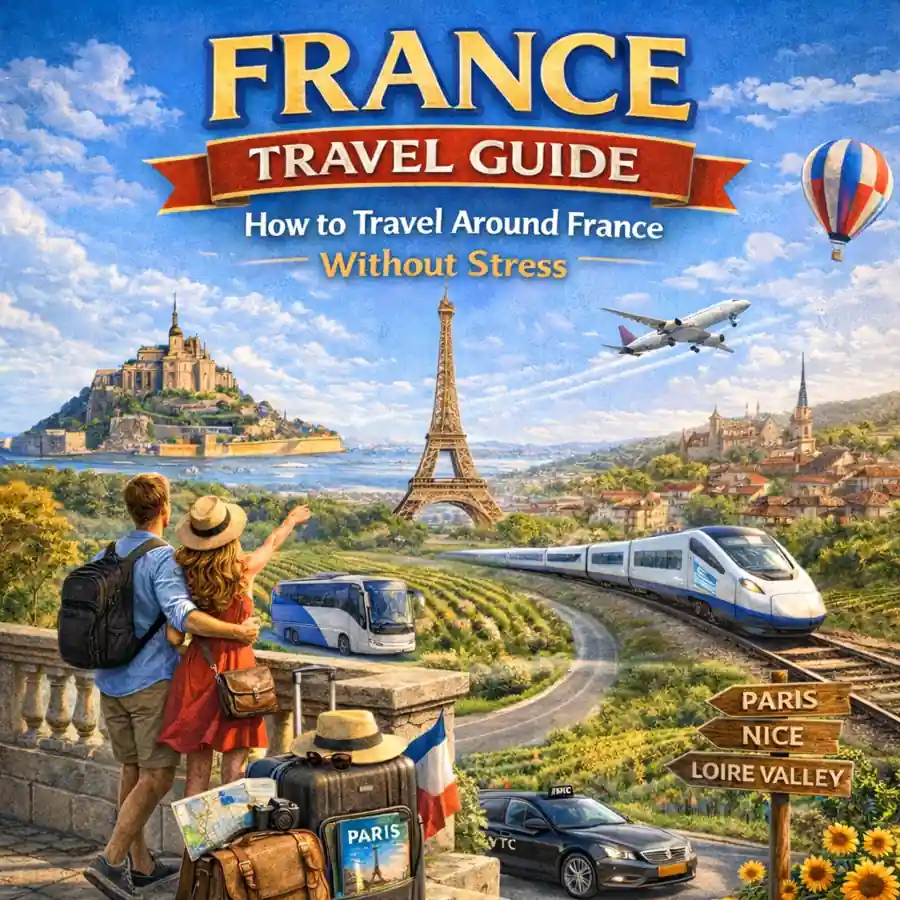
France always feels simple when you are planning it from home. You open a map and look at Paris, Nice, Lyon, Bordeaux, maybe Strasbourg too, and everything seems close enough. It feels like one of those trips that will just flow naturally. Then the real journey begins. A train platform changes at the last minute, your suitcase suddenly feels twice as heavy, the station is louder than expected, and one small delay starts affecting the whole mood. That is the part people rarely talk about. Traveling around France is beautiful, rewarding and honestly one of the best parts of the trip, but it becomes far more enjoyable when your France travel plan feels calm instead of overloaded. So lets discuss France Travel Guide in detail.
The Best Way to Keep France Stress Free
The biggest secret is not some hidden app or some clever travel hack. It is simply this: try to see less. That sounds strange because France gives you so many tempting options. Every city looks worth visiting and every region has its own charm. But once a trip turns into a race, the country starts feeling tiring instead of charming. A better rhythm is slower travel. Fewer hotel changes. Fewer long transfer days. More time to actually sit somewhere, look around, eat properly and feel like you arrived instead of just passed through. That is what makes the trip feel smooth.
You may also Like:
Trains Are Great for the Big City Routes
If your route includes major cities, trains are usually the easiest option. France does trains very well and that alone removes a lot of travel stress. Going from Paris to Lyon, Paris to Bordeaux or Lyon to Marseille can feel surprisingly easy when compared with airport check ins, security lines, baggage worries and extra transfers from airports into the city. With a train you normally reach the station, find your seat, settle in and the journey starts. That simple process can protect your energy in a big way.
I still remember one train ride where I barely did anything except look out the window and sip bad station coffee and somehow that became one of the nicest parts of the day. Fields, small towns, changing skies. It felt peaceful. Travel does not always need to feel productive every second. Sometimes the quiet movement itself becomes part of the memory.
A Car Makes More Sense in the Countryside
At the same time, trains are not the perfect answer for every trip in France. If you want tiny villages, wine areas, lavender fields, coastal roads or mountain towns, a car can make everything easier. This is where many first time visitors get caught. They assume the whole country should be explored by rail because it sounds stylish and efficient. That works well for cities. It works less well when your dream trip involves places that are smaller more spread out or harder to reach on fixed schedules.
A car gives breathing room. You can stop when a village looks interesting. You can pull over when the road suddenly opens to a great view. You can take a longer lunch without worrying about missing a departure. In those parts of France, driving often feels less stressful than trying to force public transport into a route that clearly wants flexibility.
Mixing Travel Styles Usually Works Best
The easiest France trip often uses both methods. Train for the long city jumps. Car for regional wandering. That balance is usually much smoother than choosing one style and sticking to it stubbornly. People sometimes think a trip needs one perfect transport method from start to finish. It really does not. France is the kind of place where changing your approach by region makes a lot of sense.
You might arrive in Paris, use the train to reach Lyon then rent a car for a few days in Provence. That kind of plan feels natural. It follows the shape of the country instead of fighting it. And when the route feels natural, your brain stays calmer too.
Hotel Changes Can Ruin the Mood Faster Than Delays
One thing that creates stress very quietly is changing hotels too often. It sounds manageable on paper. In real life it can drain the fun out of the whole trip. Packing every morning, checking out, moving bags, finding the next place adjusting to a new neighborhood and repeating that cycle again and again can wear you down even when everything goes right. If anything goes wrong, the tiredness hits even harder.
A much better idea is choosing a base and staying there for a few nights. Paris works well for this. Nice too. Lyon as well. From one base, you can explore nearby places without turning every day into a moving day. That makes the trip feel grounded. It also gives you a chance to build a tiny routine, and those little routines help more than people expect. Knowing where your morning coffee is, knowing the street back to your hotel, knowing where to buy water late at night all of that removes mental noise.
Travel Days Always Take More Energy Than Expected
This is something almost every traveler learns the hard way. A two or three hour journey is never just two or three hours. It includes getting ready, leaving the hotel, reaching the station, figuring out the platform, boarding, arriving finding a taxi or bus or walking route, checking in again and settling down. Half the day disappears before you even notice. That is why trying to sightsee heavily on transfer days usually backfires.
The more human way to plan is to treat those days gently. Let them be lighter. Maybe you travel in the morning and keep the evening free for a relaxed walk and dinner. Maybe you only visit one place after arrival instead of trying to chase a full list. That approach feels less impressive on an itinerary, but much better in real life.
Packing Light Changes Everything
I know this advice is old and a little boring, but it is true. France is easier with lighter luggage. Stations have stairs. Streets can be uneven. Hotels can be charming but small. Elevators can be tiny or missing. A heavy suitcase can turn an easy arrival into a sweaty, annoying experience in minutes. The lighter you pack, the easier the country becomes.
I have honestly seen people start arguing with each other over bags before they even reached the hotel. It sounds funny later but at the time it ruins the mood. A manageable suitcase or a backpack plus one smaller bag can save a lot of energy. Travel feels far more graceful when your belongings are not fighting you.
You may also Like:
Booking Early Helps More Than People Think
France can be wonderfully smooth when a few important parts are booked in advance. This matters especially for major train routes. Prices can rise and good times can disappear. When the key legs of the trip are already sorted, your mind stays lighter because the foundation is stable. You still have freedom in the days themselves, but the big movements are already safe.
That does not mean every second needs to be planned. Actually, overplanning can make the trip feel stiff. But the long distance parts are usually worth organizing ahead of time. It gives structure without making the trip robotic.
Big Cities Are Easier When You Keep Things Simple
Cities in France can feel intense at first, especially Paris. The mistake many people make is trying to master the whole transport system immediately. That is unnecessary. Before arriving, it is enough to know how to get from the station or airport to your accommodation, what neighborhood you are staying in and what you want to see first. That small amount of preparation is usually enough to make the first day feel under control.
Once you arrive, the rest starts making more sense. Paris metro maps look messy until they stop looking messy. Lyon feels straightforward after a little walking. Nice becomes easy once you understand the seafront and the older streets. There is no prize for learning everything before landing. A bit of confusion at the start is normal. That is part of travel too.
France Feels Better When the Trip Has Space in It
One reason people fall in love with France is that the country rewards slower moments. A quiet breakfast. A bakery stop. Sitting in a square longer than planned. Taking a side street just because it looks pretty. These are small things, but they add warmth to the trip. When every hour is tightly scheduled, those moments disappear.
And honestly, those soft moments often become the real memory. Not always the famous monument, not always the museum, not always the photo you expected. Sometimes it is a simple walk after dinner in a place you had never heard of before. France is very good at giving you that feeling, but only if the schedule leaves room for it.
Language Worries Are Usually Bigger in the Mind
A lot of people worry about moving around France because of language. In practice, it is usually manageable. A few polite words help a lot. A hello, a thank you, a sorry, that kind of thing. Starting with courtesy changes the tone of the interaction. Even if the rest turns into gestures or simple English, that small effort goes a long way.
No one needs perfect French to enjoy the country or to move between cities. Confidence grows once the trip begins. The fear before the journey is often bigger than the actual problem.
The Route Matters More Than the Number of Places
A smart route can save more stress than anything else. Try to group places logically. Paris and nearby day trips. Lyon and the surrounding region. Nice with the coast. Bordeaux with the southwest. When the path makes geographical sense, the trip feels smoother and your days feel less broken. What causes frustration is zigzagging across the country just because many places look exciting online.
France is one of those countries where a clean route feels elegant. A messy route feels tiring. Choosing connected places gives the journey a natural shape and makes everything feel more intentional.
The Calm Version of France Is Usually the Best One
If I had to explain the easiest way to travel around France without stress in one honest paragraph, I would say this: pick fewer places, stay longer use trains for the major city routes and rent a car only where it truly adds freedom and leave enough space for unexpected pauses. France does not need to be conquered. It just needs to be experienced properly. Once the pressure drops then the country becomes much softer, much prettier and much more memorable. That is the version of France I would choose every time.