



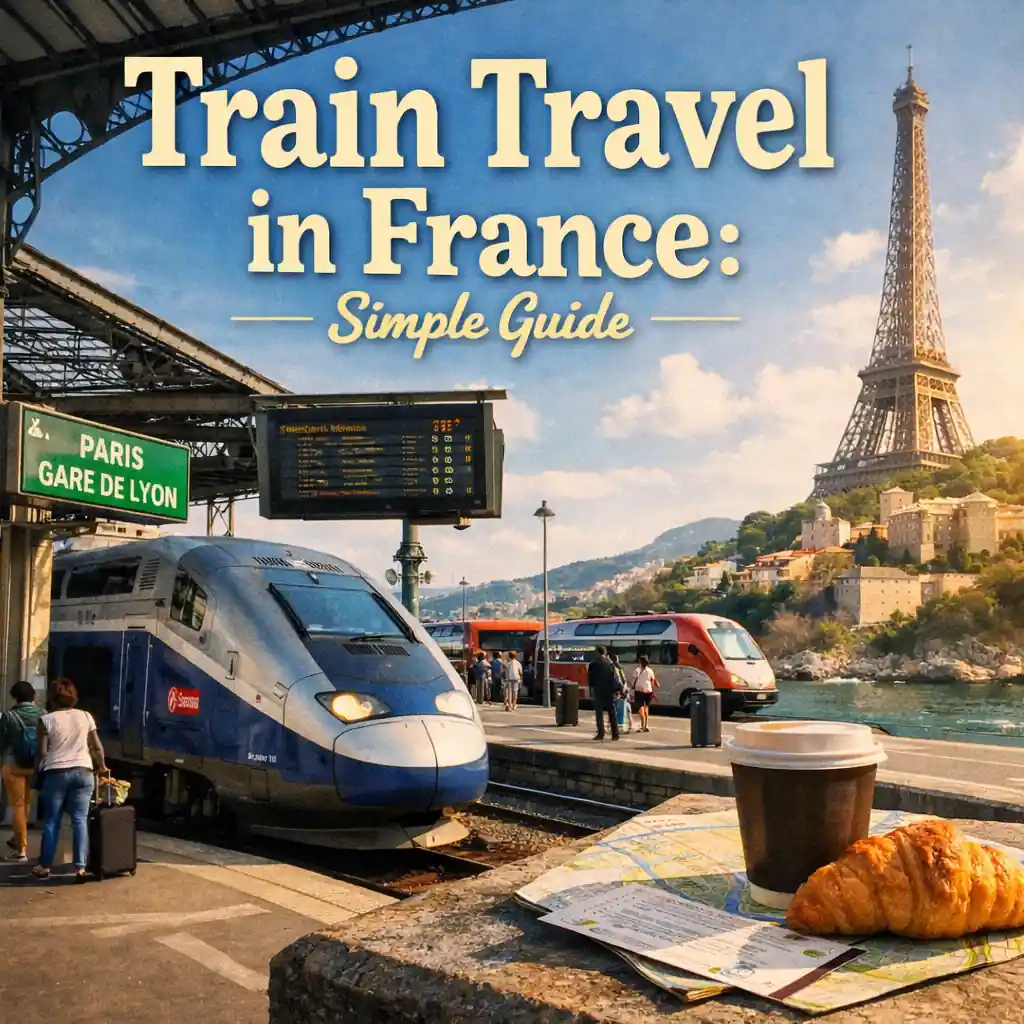
Train travel in France is one of those things that sounds ordinary until someone actually tries it. Then it becomes one of the nicest parts of the whole trip. A lot of people go to France thinking mostly about Paris cafes, museums, little villages, famous food and maybe a few pretty streets for photos. They do not always think much about the travel between places. But honestly the train rides can end up becoming part of the memory too.
There is something easy about it. Not perfect, not magical every second but easy in a real way. A person can leave one city in the morning and by lunchtime be somewhere that feels completely different. That shift is what makes France fun to explore. Paris feels one way, Lyon feels another, Nice feels softer and brighter, Strasbourg has its own mood and the train is what lets a traveler move through all of that without turning the whole trip into a headache.
I personally think train travel suits France better than almost anything else. Driving can be nice in some areas, sure but not everyone wants to deal with roads, parking, tolls and maps while trying to enjoy a holiday. Flights inside the country can save time on paper, but airports often eat up that time anyway. Trains feel more direct. More calm. More connected to the actual trip.
The First Thing to Understand Before Booking
One small thing confuses many first time travelers. They hear “train in France” and imagine one simple system where every ride works the same way. It does not really work like that. Some trains are very fast and made for big city journeys. Others are slower and more local. Some are cheap and basic. Some feel more comfortable and better for longer routes.
This is not something to worry about too much. It is just useful to know before booking. If someone is going between major cities, they will usually look for the faster options. If they are heading to a smaller town or doing a short regional journey they may end up on a local train instead. Both can be fine. It just depends on the route.
A lot of stress disappears the moment a traveler stops expecting every train to be the same.
You may also Like:
Booking Early Helps More Than People Think
This is where people often make life harder for themselves. They leave train booking for later because it feels less important than hotels or flights. Then later comes and the nice cheap tickets are gone, the convenient departure time is gone too and suddenly a simple trip starts feeling expensive or awkward.
For big routes, early booking usually helps a lot. Not in a dramatic way where someone has to plan every minute of life six months ahead, but enough that it makes a difference. If a traveler already knows they want to go from Paris to Marseille, or from Paris to Bordeaux, or from Lyon to Nice, it makes sense to sort that out earlier rather than treating it like some last little detail.
Smaller local rides are different. Those can often stay flexible. In fact, I think it is better when some part of the trip stays flexible. Travel becomes too stiff when every tiny move is locked in. The sweet spot is simple. Book the important long rides early. Leave a little breathing room for the rest.
What French Train Stations Actually Feel Like
People who have never used trains much sometimes imagine French stations as confusing giant mazes where everyone is rushing and nobody knows what is happening. That can happen in a busy station at a busy time, yes but most of the time it is more manageable than that.
The main thing is just to check the correct station name, especially in Paris. This matters more than many travelers expect. Saying “I am leaving from Paris” is not enough. Paris has several major stations and they do not all send trains to the same places. Someone can very easily look at the city name, feel confident and then realize they are standing at the wrong station with a suitcase and very little time left. That is not a fun moment.
So one tiny habit helps a lot. The night before travel, look again at the ticket. Not just the time. Not just the destination. Look at the exact departure station. That one habit can save a whole morning.
Apart from that, stations are usually not too hard to deal with. There are signs, departure boards, platforms, people moving with purpose, and usually enough structure that a traveler can figure things out without panic. It helps to arrive a bit early. Not because the process is extreme, but because travel always feels nicer when there is no last minute running.
The Best Part Is That the Journey Feels Like Travel
This might sound obvious, but I think it matters a lot. On a train, the journey itself still feels like the trip. On a plane, travel time can feel dead. It is just waiting, lining up, sitting, landing, and trying to get out. On a train, there is more life in it.
A traveler can watch cities slowly disappear and fields begin. They can see little stations, villages, church towers, patches of countryside, rivers, industrial edges, rows of houses and then suddenly a completely different region starts appearing outside the window. It feels like moving through a country instead of being dropped into it.
I still think that is one of the nicest things about train travel in France. The country changes gradually. You actually notice it. A place does not just become a name on a booking. It arrives slowly.
Sometimes the best moments are small ones. Coffee in hand. Bag near the seat. Quiet conversation. A bit of sunlight coming through the window. No drama. No airport stress. Just movement.
You may also Like:
Luggage Can Make or Break the Experience
This part is boring, but very real. Packing too much can ruin the comfort of train travel fast.
A manageable suitcase is fine. A backpack plus one small case is fine too for many people. But when someone is dragging far too much stuff, then every staircase feels personal, every platform feels longer, every train change feels annoying and even a nice station starts becoming irritating.
The problem is not only the train itself. It is the whole chain around it. Entering the station, walking to the platform, finding the coach, getting on board, lifting bags, changing trains if needed, stepping out into a new city and then reaching the hotel. Heavy packing turns all of that into work.
So the honest advice is simple. Pack less than the first impulse says. France will still be there even if someone brings fewer shoes.
Good Routes for a First France Train Trip
If someone is trying train travel in France for the first time, it helps to start with routes that are simple and satisfying. Paris to Lyon is a good example. It is a practical journey and both cities feel very different from each other. Paris to Bordeaux is another nice one especially for travelers who want a city that feels elegant without the same rush as Paris. Paris to Strasbourg is great too because it gives that feeling of entering a place with a different rhythm and style.
Then there is the south. A lot of people are drawn there for obvious reasons. Nice, Marseille, Avignon and nearby areas have that warmer mood many travelers are looking for. The train ride to that side of France can feel like part of the reward.
But honestly, the smaller places are sometimes the real surprise. A lot of famous destinations are wonderful but the regional train rides to less talked about towns can feel even more special. There is less pressure there. Less performance. Just a quieter arrival, maybe a bakery nearby, maybe an old square, maybe streets that are not trying too hard to impress anyone.
That kind of place stays with a person.
Is a Rail Pass a Good Idea
Some travelers love the idea of a rail pass because it sounds free and open. Just move around, stay flexible, keep going. That style suits some people very well. But it is not automatically the best choice for everyone.
If a trip only includes a few train journeys, separate tickets may make more sense. If someone is moving across France a lot and likes flexibility, then a pass can start to feel useful. It really depends on how the trip is built.
I would not treat a rail pass as the default smartest option. I would treat it as one possible tool. Some trips need it. Some do not.
Small Mistakes First Time Travelers Often Make
The most common mistake is trying to do too much in too little time. France may look compact on a map when fast trains are involved, but that does not mean every day should become a race from one station to another. Moving cities too often can make a nice holiday feel weirdly rushed.
Another mistake is booking too late and then feeling shocked by prices.
Another is not checking the departure station carefully.
And then there is overpacking, which really deserves to be repeated because people keep doing it anyway.
Good train travel in France is usually built on simple choices, not clever complicated ones.
Why Trains Feel So Right for France
France is one of those countries where train travel just fits. It fits the geography, the cities, the pace and even the feeling of being there. A traveler can spend the morning in one place, enjoy lunch somewhere else and still have enough energy left to walk around instead of feeling drained by the process.
That matters. The transport should not steal the trip.
I think that is the main reason so many people remember France train journeys so fondly. They are not only moving from place to place. They are staying inside the trip the whole time. The travel itself does not feel separate from the holiday. It feels like another chapter of it.
And maybe that is the simplest way to say it. Train travel in France is not only practical. It feels right.
Final Thoughts
If someone wants the easiest way to explore more than one part of France, train travel is usually one of the best answers. It is comfortable, scenic, practical and far less tiring than many people expect. A little planning helps. Booking major routes early helps too. Packing sensibly matters more than people think. Checking the right station matters as well.
But once those small things are handled, the rest becomes much smoother.
France is the kind of place where the time between destinations can still feel beautiful. That is rare. And that is why so many travelers end up talking about the train rides almost as warmly as the cities themselves.